Zola with holographic DRC map
Project 01 · Phase 1 Active

National Address Mapping

20 million addresses. Mapped at 95% accuracy. For the first time in DRC history.

The Foundation

A Country That Couldn't Find Itself

The DRC is the second-largest country in Africa, home to over 100 million people. Yet the vast majority of its addresses are informal, inconsistent, or entirely absent. Without a standardized address system, emergency services cannot find you, commerce cannot reach you, and government cannot serve you.

Palm Leaf Partners' National Address Mapping program changes this. It is the foundational layer on which every other infrastructure project is built — not merely a database, but the operating system of a modern nation.

And critically: the call center emergency dispatch system depends entirely on this map. When a citizen dials for help, the dispatcher needs a precise, verified location. That precision is what this project delivers.

0
Addresses to Assign
95%
Accuracy Target
0+
Post Office Hubs
0
Year Partnership

"Authorized under the Memorandum of Understanding with SCPT — the DRC's national postal authority — and governed under DRC PPP Law 20/018 (2020)."

01 We start in orbit.

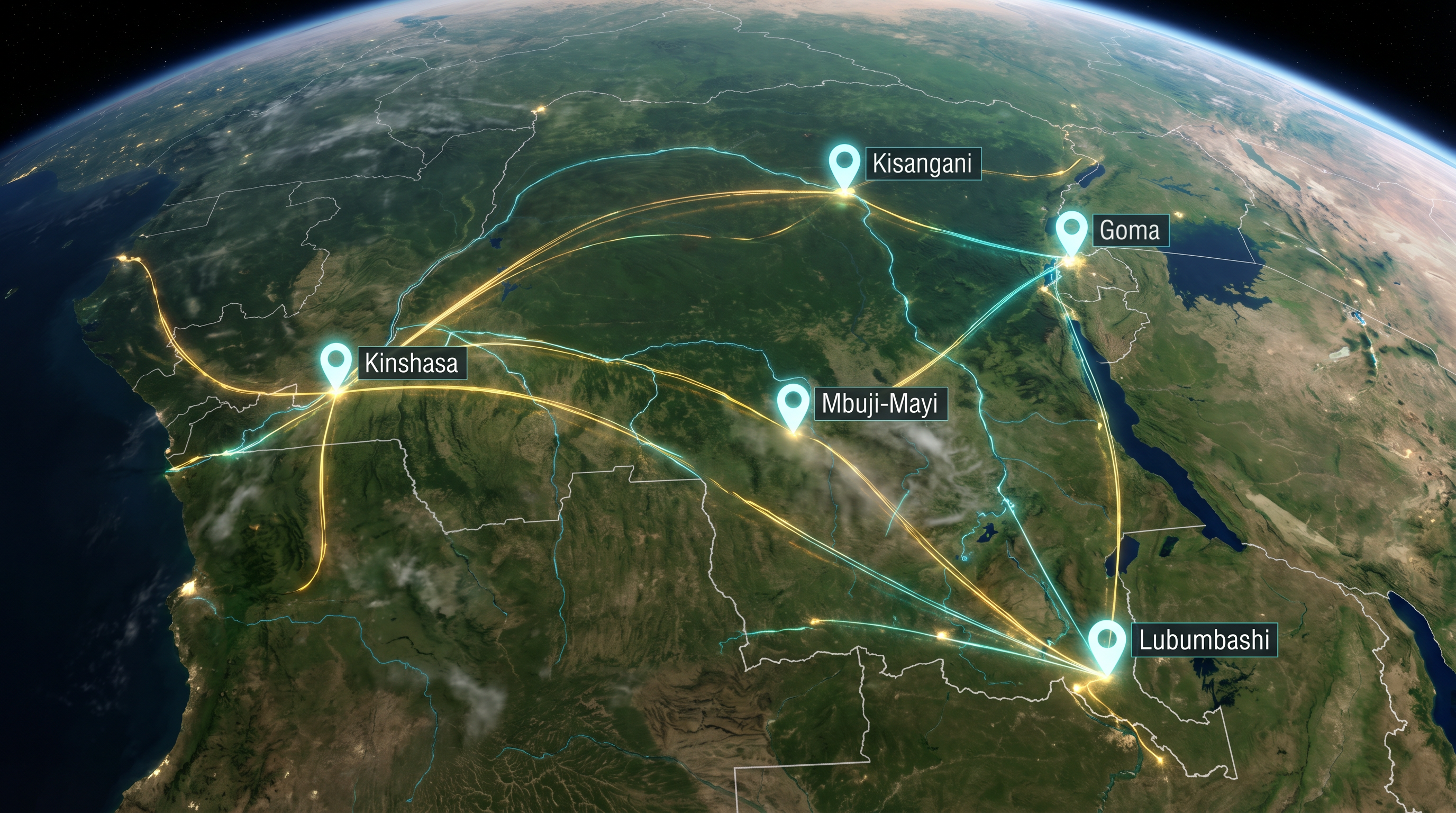
Satellite imagery and LiDAR drones give us the canvas.

Before a single field collector steps out of a vehicle, we have already seen the country from above. High-resolution satellite imagery and LiDAR drone surveys map every structure, road, and landmark across all 26 provinces — giving our teams a verified canvas to work from. Nothing is assumed. Everything is confirmed.

Satellite view of DRC with mapping pins
Zola guides you through the project

"We see the whole country before we touch a single door. That's how you build something that lasts."

Zola · Palm Leaf Partners

Field collector at a doorstep in the DRC
02 We finish at the front door.

Three thousand field collectors. Every address. Validated in person.

Field teams — trained, equipped, and locally hired — visit every structure. They capture precise GPS coordinates, photograph the location, assign a standardized address code, and affix a QR-coded placard at the door. Every address is validated twice: once in the field, once in the national registry. No shortcuts. No estimates.

Up to 100 modernized SCPT post office hubs serve as the physical registration points — every one connected by Starlink, every one staffed to serve citizens in their own language.

Zola

"Every address is a person. Every person deserves to be found — by their family, by their doctor, by emergency services."

Zola · Palm Leaf Partners
03 And the country gets a new map.

A bilingual analytics dashboard. Postal facilities going live. A public address-verification API.

When the field work is done, the DRC has something it has never had before: a complete, verified, publicly accessible national address registry. Bilingual (French + local language) analytics dashboards give government agencies real-time visibility. Post offices go live as citizen service centers. And a public address-verification API opens the registry to commerce, banking, healthcare, and logistics — for the first time.

Zola with the DRC holographic map
Multilingual Program

Six Languages. One Nation.

Français
Official National Language
Lingala
Kinshasa & Northwest DRC
Swahili
Eastern DRC
Kikongo
Kongo Central & Southwest
Tshiluba
Kasai Provinces
English
International & Business
Inside the Build — Technical Details
  • GPS field capture with dual-validation protocol
  • National address schema: province · territory · commune · street · number
  • QR-coded physical address placards at every registered location
  • Stored in sovereign Tier-IV Data Center, Kinshasa
  • Public address-verification API for commerce, banking & logistics
  • Bilingual analytics dashboards for government agencies
  • Direct integration with call center emergency dispatch system
  • Citizen registration via 100+ SCPT post offices, all Starlink-connected

The Map That Makes Everything Possible

Address mapping is the first step. See how it powers the call center emergency dispatch system — and why it matters.

See Call Centers →