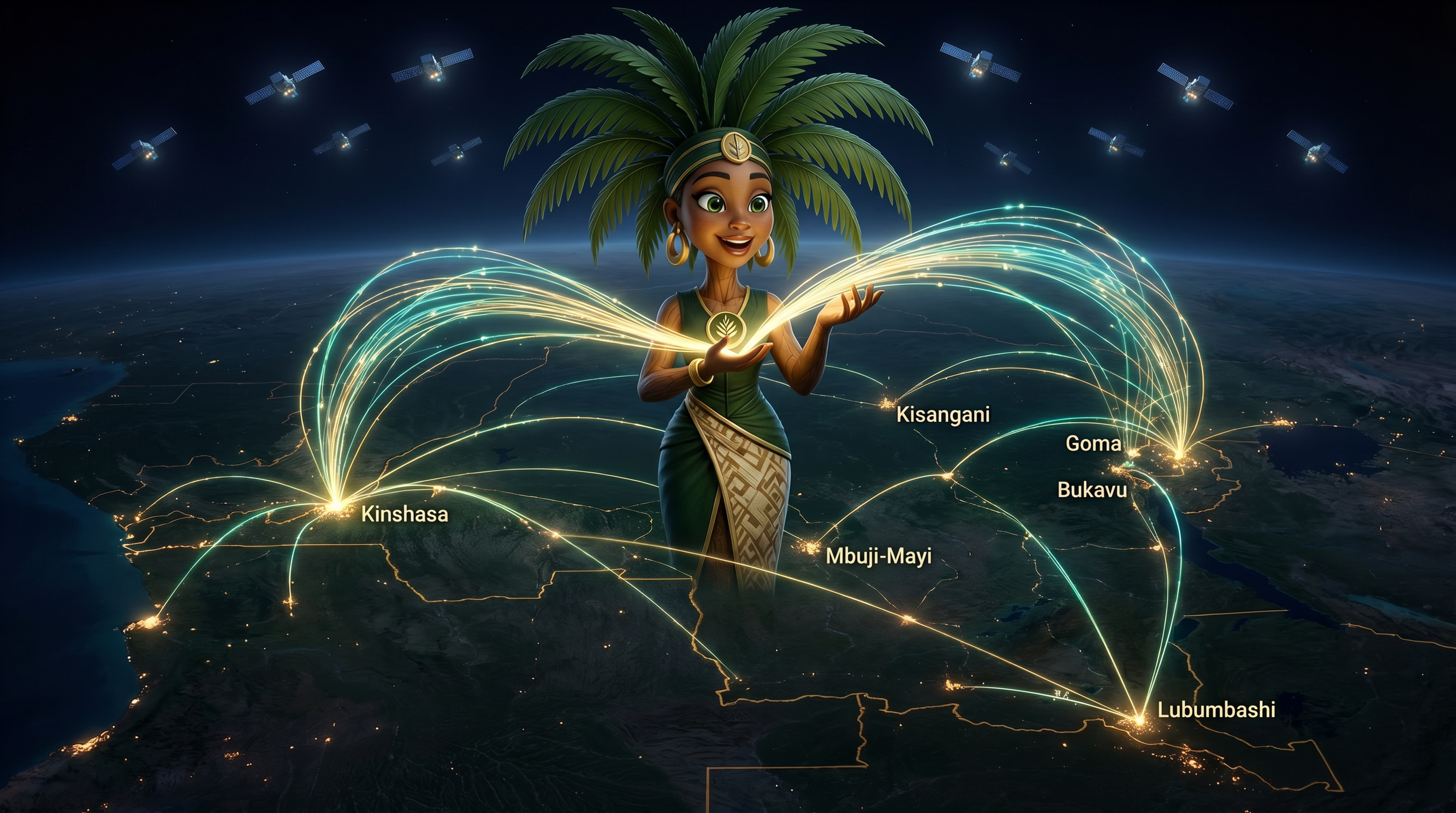
Zola holding glowing fiber strands over the DRC at night
Project 04 · Phase 2 Development

National Fiber Backbone

Six cities connected. One hundred remote sites reached. A 25-year partnership that lights up the DRC.

National Connectivity

Lighting Up the DRC

The Democratic Republic of Congo spans 2.3 million square kilometers — larger than Western Europe. Its cities are separated by vast stretches of rainforest, river, and savanna. Today, high-speed internet connectivity is available to only a fraction of the population.

Palm Leaf Partners' National Fiber Backbone changes this. A high-capacity fiber optic network connects six major cities — Kinshasa, Lubumbashi, Goma, Kisangani, Mbuji-Mayi, and Bukavu — creating the arterial network on which all other digital services depend.

For the vast rural areas between these cities, Starlink satellite integration provides last-mile connectivity — ensuring that the benefits of the fiber backbone reach communities that ground-based infrastructure cannot economically serve.

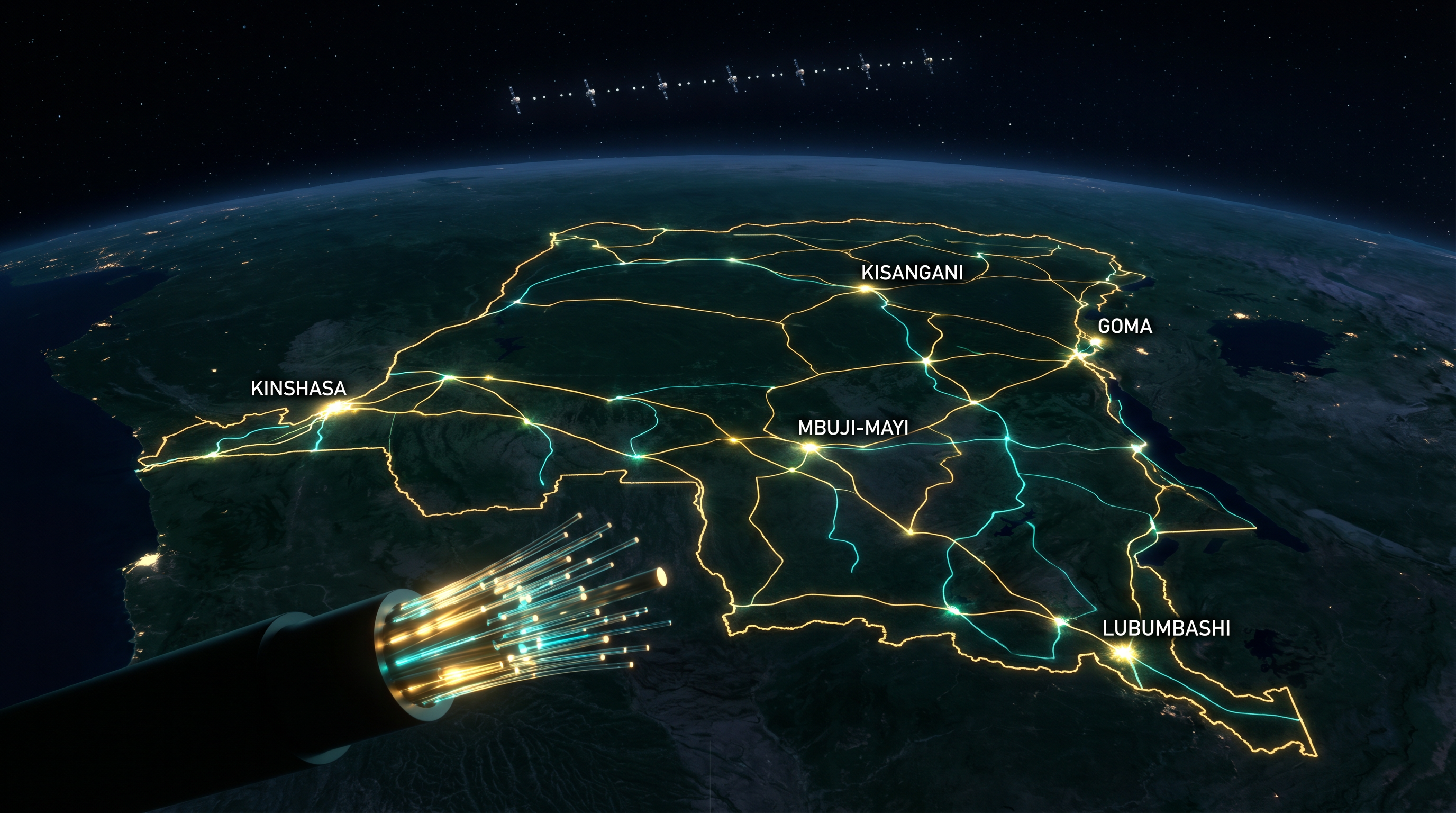
Fiber backbone night map
01 The arteries of a nation.

Six cities. One ring. No single point of failure.

The backbone follows the DRC's major population corridors — Kinshasa to Lubumbashi, Kinshasa to Kisangani, Kisangani to Goma, Goma to Bukavu, Bukavu to Lubumbashi, and Mbuji-Mayi as the central hub. A ring topology means that if any single cable is cut, traffic automatically reroutes within milliseconds. The country stays connected.

Glowing fiber network over DRC at night
Zola

"A ring means no single break can silence a city. We designed for resilience because the DRC deserves infrastructure that holds."

Zola · Palm Leaf Partners
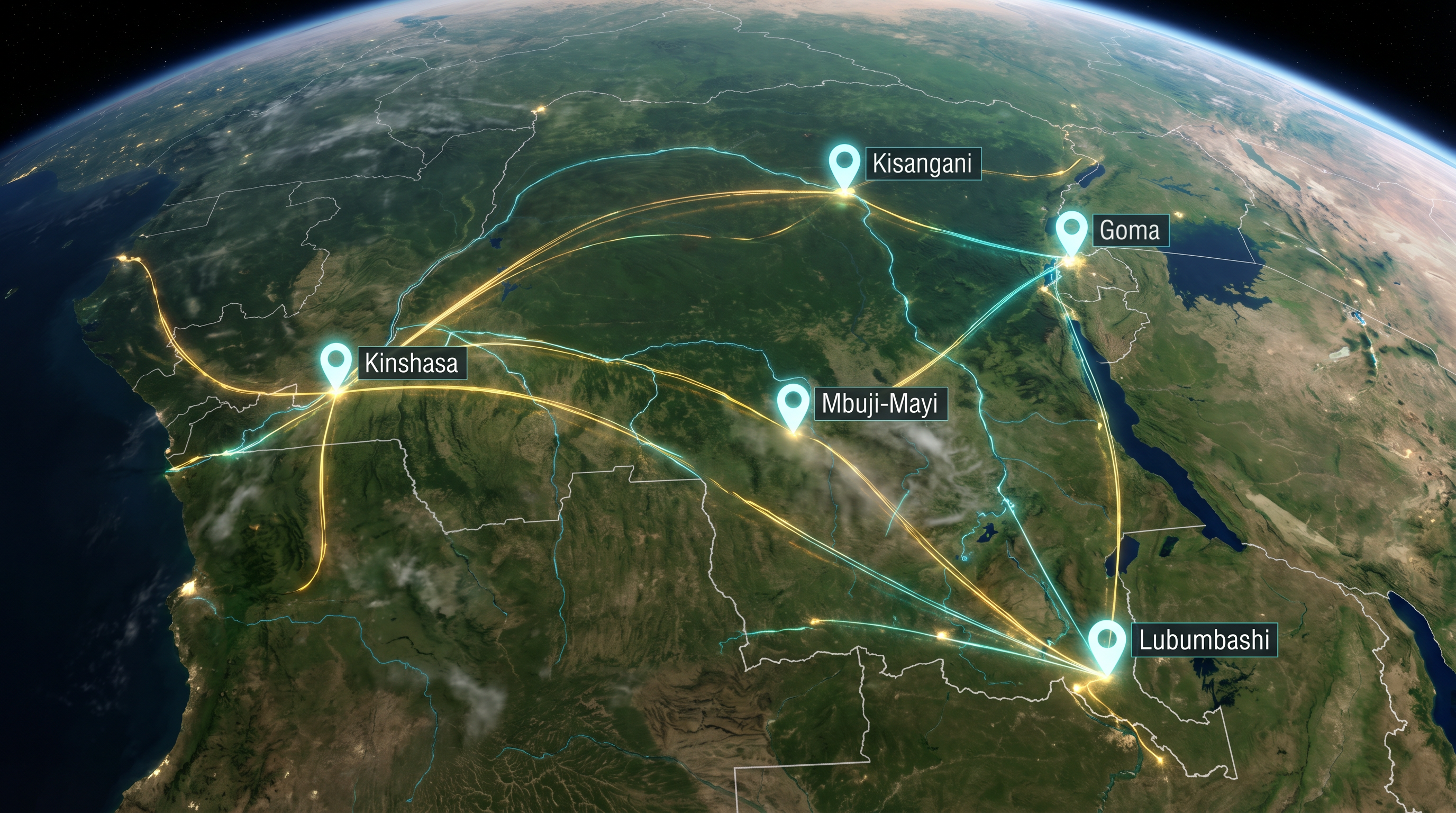
Satellite view of DRC connectivity
02 Where fiber ends, Starlink begins.

Microwave reach to 100+ remote sites. Starlink for the last mile.

The DRC's rural communities — home to tens of millions of people — are separated from major cities by distances that make ground-based fiber economically unfeasible. Palm Leaf Partners integrates Starlink low-Earth-orbit satellite connectivity to bridge this gap. Terminals deployed at SCPT post office hubs, schools, health centers, and community points provide broadband-speed internet to communities that have never had reliable connectivity.

Zola

"The fiber reaches the cities. The satellites reach everyone else. No community is left behind."

Zola · Palm Leaf Partners
03 The network that carries everything.

The address registry. The data center. The call centers. All carried on this backbone.

The fiber backbone is not just an internet service — it is the circulatory system of the entire Palm Leaf Partners infrastructure ecosystem. The national address registry flows through it. The data center's redundant links run on it. The call centers' low-latency dispatch connections depend on it. Government services, financial inclusion, telemedicine, and remote education all ride this network.

Zola with fiber connections

What the Backbone Enables

  • High-capacity links to the Tier-IV data center in Kinshasa
  • Low-latency connections between all regional call centers
  • Real-time access to the national address database from any point
  • Digital government services accessible from all 26 provinces
  • Mobile banking and fintech services reaching unbanked communities
  • Telemedicine and remote education for communities across the DRC
Inside the Build — Technical Specifications

Single-Mode Fiber

G.652D single-mode fiber optic cable in armored conduit — designed for 40+ year operational life with minimal signal degradation.

DWDM Technology

Dense Wavelength Division Multiplexing enables multiple simultaneous high-capacity data streams on a single fiber pair.

Redundant Ring Topology

Automatic failover ensures that no single cable cut can disrupt the network — traffic reroutes within milliseconds.

The Network That Connects Everything

The fiber backbone carries the data that powers the address registry, the data center, and the call centers — one connected system.

See the Data Center →